


There’s a point where learning stops looking like progress.
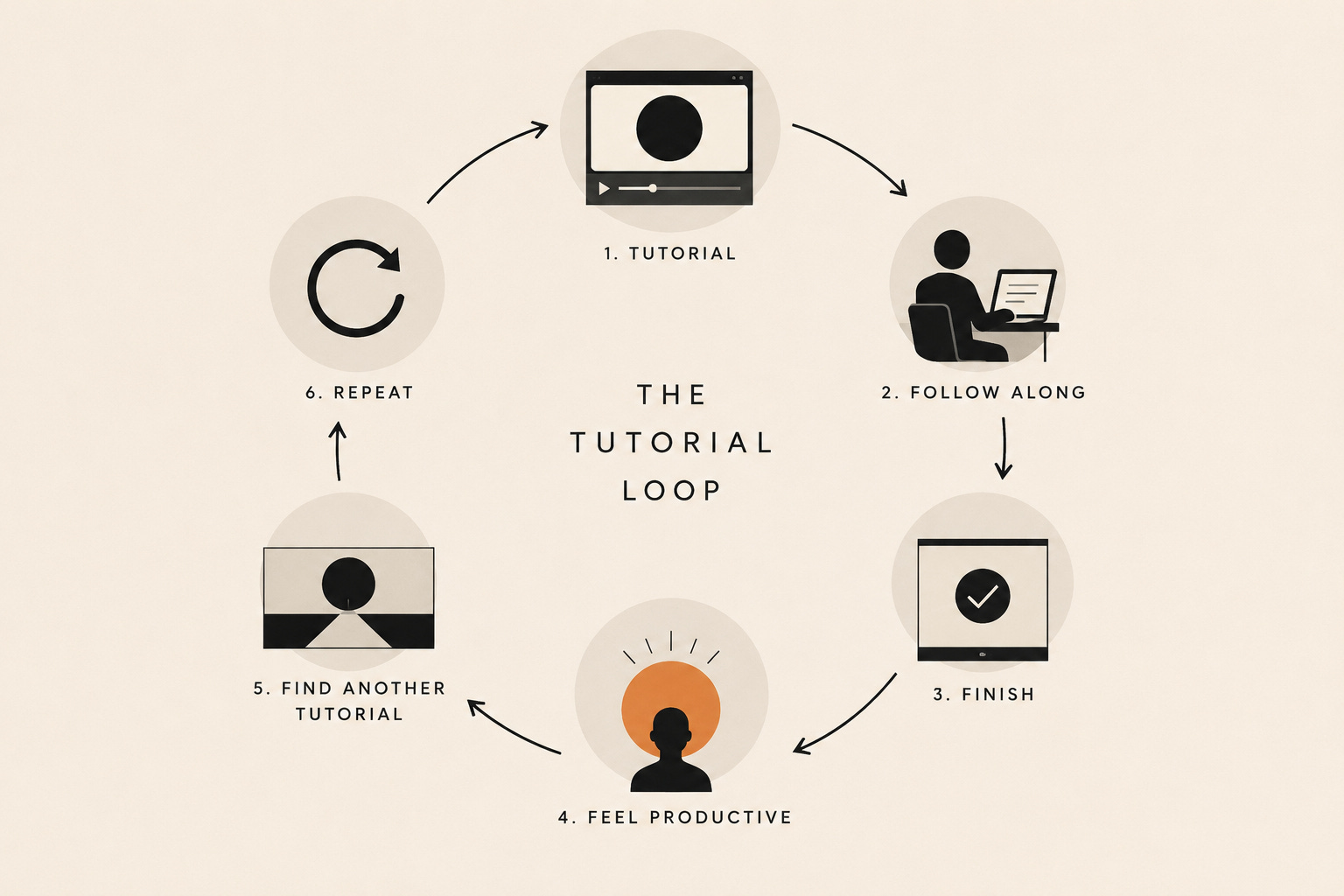
You’ve watched the walkthroughs. Saved the resources. Followed a few creators who seem to know what they’re doing. Maybe you’ve even completed a course or two.
You understand the interface. You know the terminology. You can follow along when someone else is building.
Then you open a blank project and suddenly realize you have no idea where to start.
I’ve been there more times than I can count.
It’s easy to mistake familiarity for ability. Watching someone build a website makes the process feel understandable. Following an AI tutorial makes the workflow seem obvious. Recreating a design step by step can make you feel like you’ve picked up the skill.
But following instructions and making decisions are two very different things.
A tutorial has already solved most of the difficult problems for you.
Someone else decided what to make. They chose the tools. They figured out the structure. They encountered the problems, found the solutions, cleaned everything up, and packaged the process into something you can follow from beginning to end.
That’s useful when you’re getting started.
Eventually, though, you have to remove the instructions.
Give yourself a problem
One of the biggest changes I’ve made in how I approach new skills is simple: I try to find something to make as quickly as possible.
Not a practice exercise.
Something with a purpose.
A website that needs to work. A template someone else could actually use. A small tool that solves an annoying problem. A redesign with constraints beyond making it look good.
The project doesn’t have to be groundbreaking. It doesn’t even have to become a business.
It just needs to force decisions.
That’s where a different kind of learning starts.
Instead of asking, “What should I learn about this tool?” you start asking much better questions.
How do I make this particular thing work?
Why is this breaking?
Is there a simpler way to structure this?
What happens on mobile?
How should someone move through this?
Can I reuse this instead of building it again?
Why did this look good in my head and terrible once I actually made it?
Those questions are difficult to manufacture inside a tutorial because they come from the project itself.
You start looking for information because you need it, not because someone put it in the next module.
The gaps become obvious
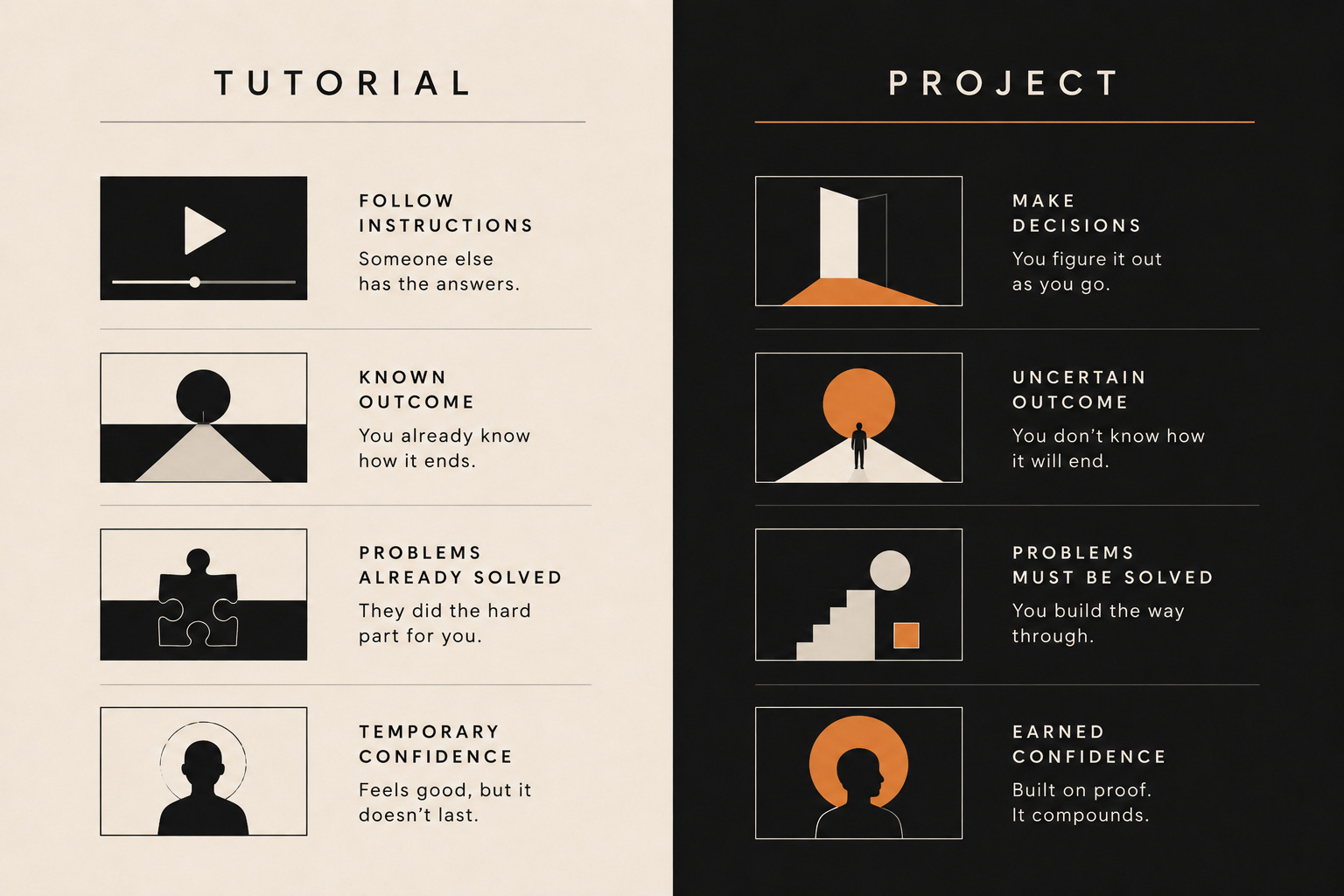
Projects are also good at exposing what you don’t know.
That can be uncomfortable.
You can spend hours consuming information and feel increasingly competent because everything makes sense while someone is explaining it. A blank canvas is less forgiving.
It immediately shows you where the gaps are.
That’s a good thing.
When I’m making something, I don’t need to understand every feature of every tool involved. I need enough knowledge to get from where I am to the next problem.
Then I solve that problem.
And then the next one appears.
Over time, those solutions start connecting.
Something you figured out while building one project becomes the obvious answer on another. A mistake that took an hour to diagnose the first time takes five minutes the next time. Eventually, you stop thinking about certain decisions altogether.
That’s when knowledge starts becoming skill.
Tutorials still have a place
None of this means tutorials are useless.
I use them all the time.
Documentation, YouTube videos, articles, AI, courses, forums, examples from other people’s work. There has never been a better time to find an answer when you’re stuck.
The difference is what comes first.
Instead of learning everything and hoping I’ll eventually find somewhere to use it, I’d rather start making something and learn what the project demands.
That changes the relationship with educational content.
A twenty-minute video becomes much more valuable when minute fourteen contains the exact solution to something that has been blocking you for the last hour.
You’re not collecting information anymore.
You’re applying it.
Build something slightly beyond you
There’s another advantage to project-driven learning: you control the difficulty.
If the project only requires things you already know how to do, you probably won’t learn much.
If it requires twenty things you don’t understand, you’ll probably abandon it.
The useful projects sit somewhere between the two.
You know enough to imagine how you might build them, but there are still parts that make you think, I have no idea how I’m going to do that.
Those are usually the parts worth doing.
Maybe you know how to design a landing page, but you’ve never built a reusable component system.
Maybe you know basic development, but you’ve never connected an API.
Maybe you use AI every day, but you’ve never tried turning one of your workflows into an actual tool.
Maybe you’ve built websites, but you’ve never packaged something so another person could use it without you explaining how.
Now you have a reason to learn.
And more importantly, you have a way to know whether you actually learned it.
The thing either works or it doesn’t.
Your projects become proof
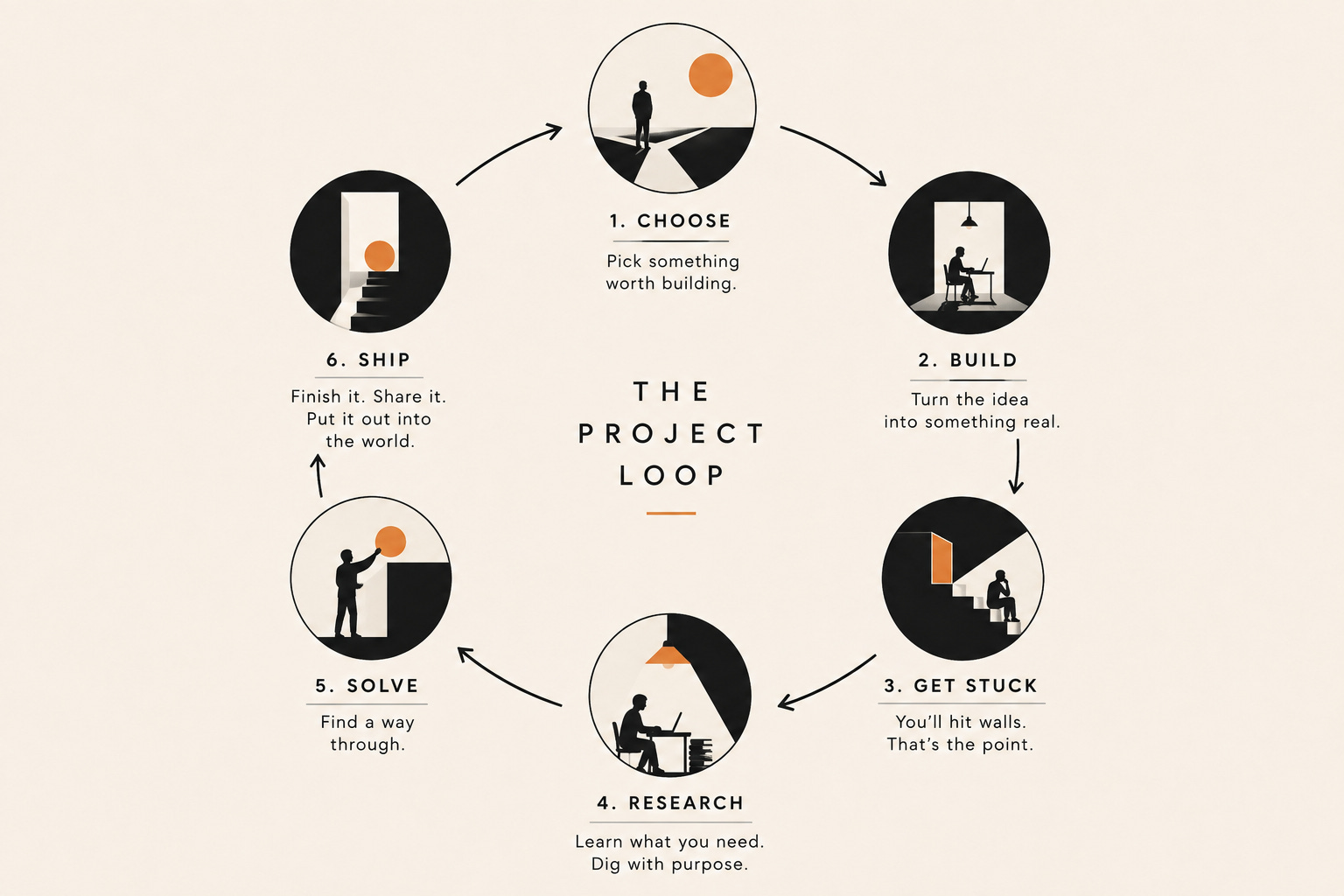
There’s a practical benefit to this approach too.
When you finish a course, you have completed a course.
When you finish a project, you have something you can point to.
It can become a portfolio piece, a case study, a product, an experiment, a conversation starter, or simply evidence to yourself that you can take an idea from nothing to something tangible.
Even projects that go nowhere can leave something behind.
The abandoned website might teach you responsive design.
The tiny app nobody uses might teach you how authentication works.
The template that never sells might completely change how you think about reusable systems.
The project can fail and still do its job.
That’s a much better deal than waiting until you feel qualified enough to start.
Start before you know enough
I don’t think the goal is to stop learning.
It’s to stop treating learning and doing as separate stages.
You don’t have to finish every course before opening the software.
You don’t need to understand an entire programming language before making something with it.
You don’t need to master design before publishing your first site.
Learn enough to begin.
Then let the project show you what comes next.
Pick something small enough to finish and difficult enough to make you search for answers.
Give it a name.
Give it a purpose.
Put a deadline on it if you need one.
Then start making decisions without someone on the screen telling you which button to press next.
You’ll probably get stuck.
Good.
Now you have something worth learning.